
Evanston City Directory Holdings
Evanston's historical shelf is split among several custodians. The Evanston Public Library Evanstoniana Room holds paper and microfilm directories beginning in 1879. Northwestern University Archives has hard copies and film described in a Chicago Collections guide. The Evanston History Center adds directories, telephone books, maps, and house files. Each place answers a different request.
| Collection | Years | Where held | Access |
|---|---|---|---|
| Evanston city directories | 1879 onward | EPL Evanstoniana | Paper, microfilm, staff help |
| Northwestern runs | 1874/75-1917, with gaps | Northwestern archives | Hard copy, film, selected scans |
| Gale reel bibliography | 1882/83-1931, with gaps | Finding aid | Verify the reel holder |
| 1899 directory | 1899 | Internet Archive | Free images and OCR |
| Telephone books | 1926-present as listed | Evanston History Center | Research room |
Ranges overlap but are not identical. A missing reel at one archive does not prove no volume was issued. Ask staff to check nearby runs and alternate publishers.
Evanston Directory Publishers and Gaps
Higgs & McNally published an Evanston directory beginning in 1879. R.R. Donnelley & Sons appears in the 1880-1881 run. Northwestern's guide records hard copies for 1895-1899 and 1901-1905, plus film that reaches into 1917. HathiTrust copies cover selected years, not a seamless set.
The Gale bibliography maps reels through 1931 and flags missing years in particular runs, including 1885, 1887, 1911, 1916, 1926, and 1930. It is a finding aid, not proof that every reel sits at EPL. Check Northwestern, EPL, EHC, and the listed repository.
Inside Evanston's 1899 Directory
The digitized 1899 Evanston Directory lets a researcher inspect the full volume online.
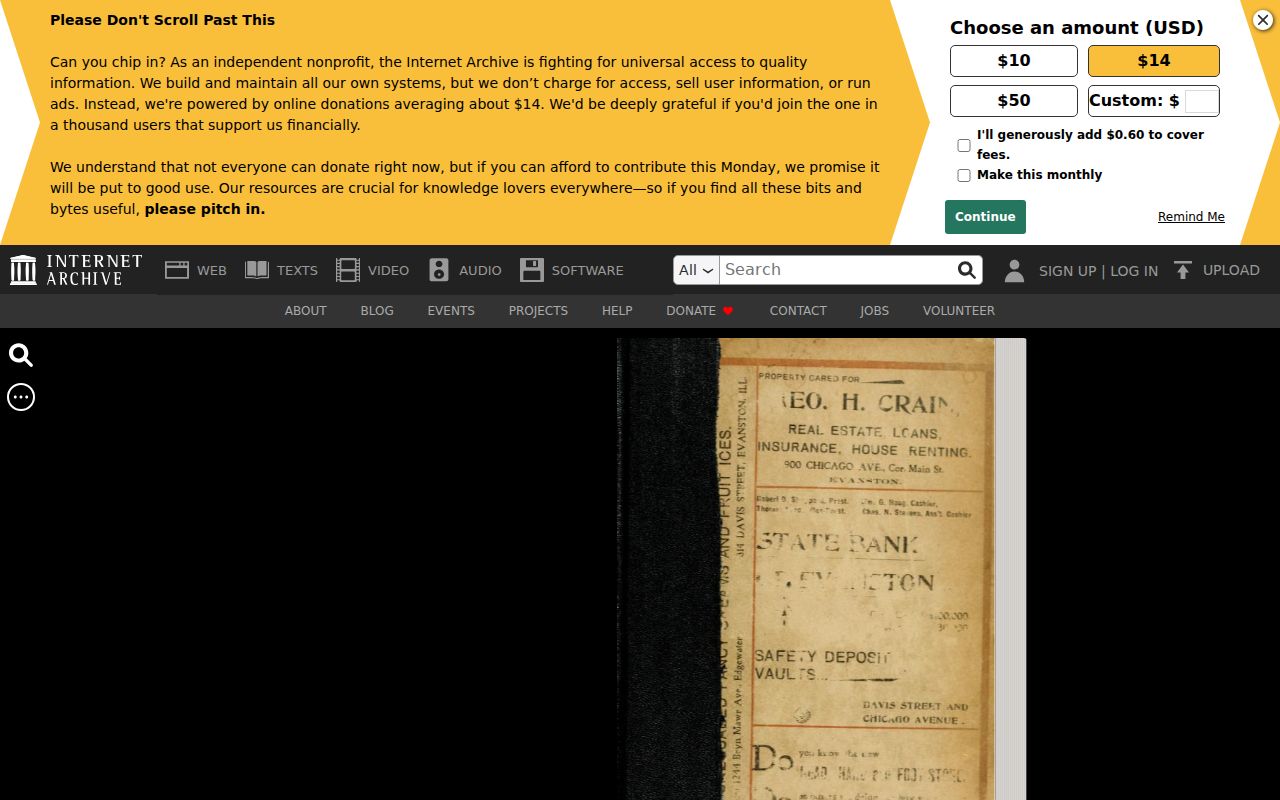
The capture leads to page scans and OCR, but the image controls when letters, initials, or phone digits are unclear. Front matter lists streets, schools, churches, societies, and city facts before resident and business entries.
That pattern explains why an Evanston home and Chicago workplace can share one line. The work address does not cancel the local residence.
Read an Evanston Directory Entry
Read the publisher's key before interpreting a line. The 1899 scan uses av for avenue and tel for telephone. A spouse may appear in parentheses. Work, school, church, or trade may follow the home address. Period terms should be copied with care and never turned into a present-day claim.
| Name | Surname first, then given name or initials. |
|---|---|
| Household | A spouse or relationship may be in parentheses. |
| Residence | Number, street, and abbreviated suffix. |
| Telephone | A local number when listed. |
| Role | Trade, employer, school, church, or business. |
- Criss-cross directory
- A directory ordered by street or phone rather than just surname.
- Householder index
- An address list tied to the person printed there.
- Abbreviation key
- The publisher's list of short forms.
- OCR
- Machine-read scan text that can misread old type.
Evanston City Records at EPL
The Evanstoniana Room on the Main Library's second floor is the local start for directories, newspaper film, maps, yearbooks, and obituaries. The library records page confirms city directories, microfilmed phone books, and local obituaries.
The captured page shows the library's own description of those holdings.
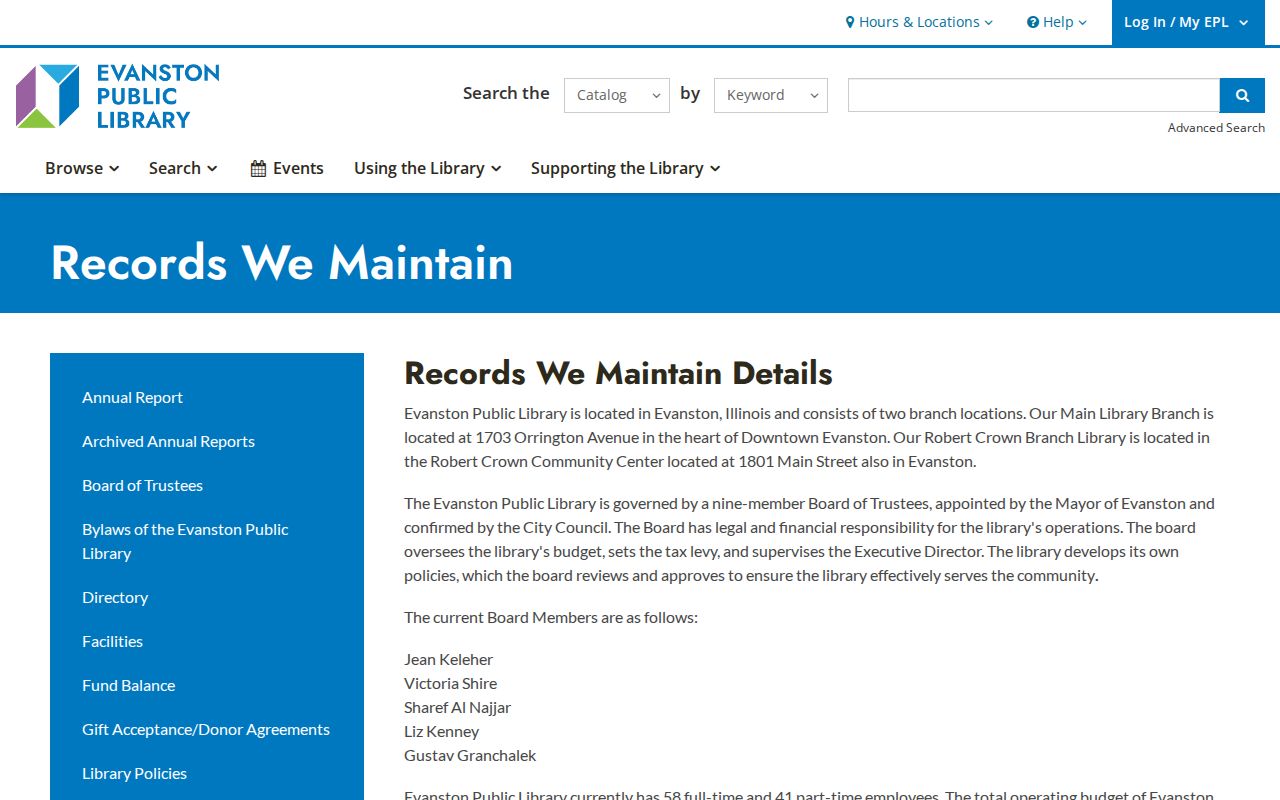
Staff may help a remote researcher, though a fee can apply. Copyright, fragile condition, and collection rules can limit copies. Library-card databases include HeritageQuest and MyHeritage Library Edition.
EPL also lists the Evanston Index for 1872-1914, Evanston Press for 1889-1914, and later local papers. A notice can add family context, but it is not a certified record.
Evanston House Files and Phones
The Evanston History Center collections add telephone books from 1926 to the present as listed, maps, photos, oral histories, building records, and house files. The Research Room is at 225 Greenwood Street. Listed hours are Tuesday, Wednesday, Thursday, and Saturday from 1:00 to 4:00. Admission is $5, with members free.
The collection image shows where directory and building sources sit in the archive.
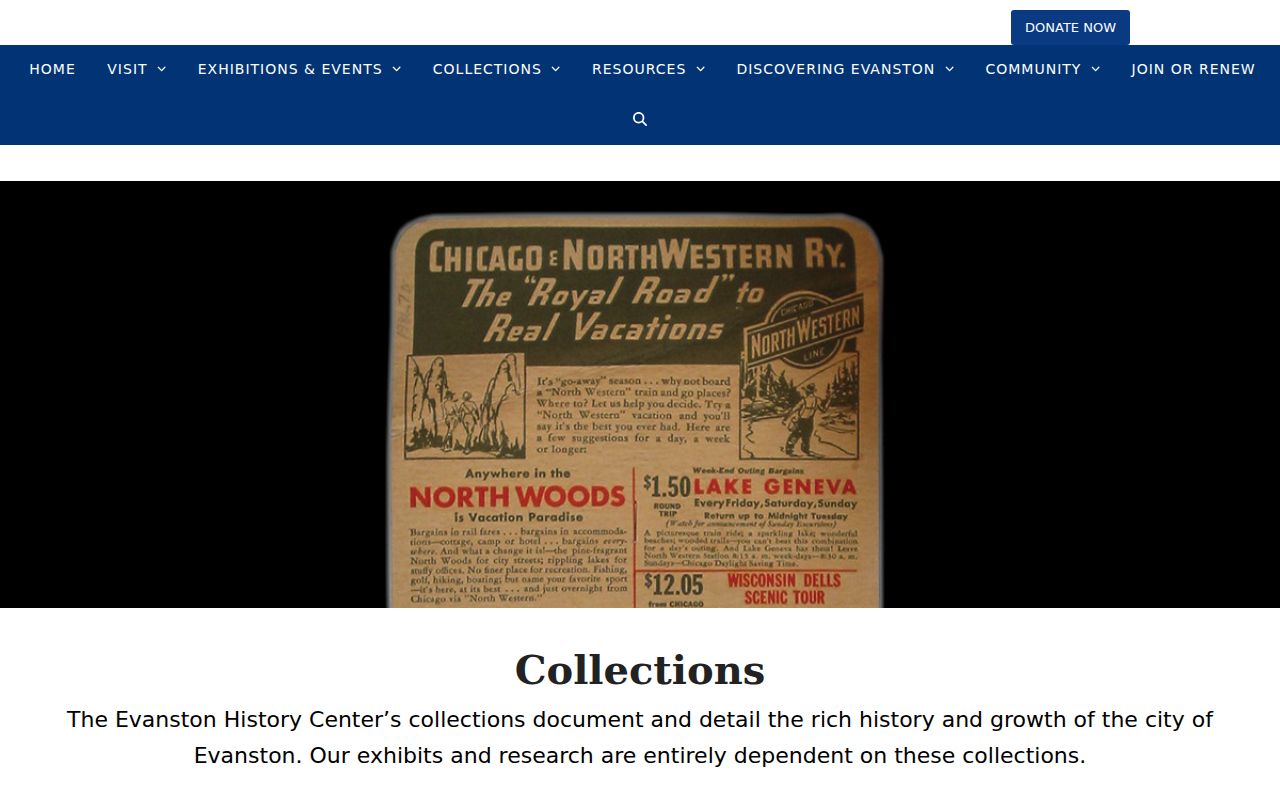
Use a house file when a name search becomes an address question. It may link listings, property notes, maps, and sale material, but does not prove a person stayed for a full directory year.
An Evanston Archive Saved in 1898
The Evanston History Center traces its start to an early record book rescued from a dustbin in 1898. Its archive now describes more than 100,000 artifacts. The story shows why survival often depends on a collector or local institution. No one catalog captures every Evanston name.
Northwestern archives, Shorefront Legacy Center, Frances Willard archives, schools, churches, and civic collections add voices that a publisher may have omitted or labeled poorly. Shorefront is especially relevant for Black history in Evanston and the North Shore. University collections add campus publications, alumni material, yearbooks, maps, and institutional files. A school, church, cemetery, station, or civic building may appear beside households in an old volume, so classify the entry before treating its address as a home.
Access varies by collection. Contact the archive before visiting, describe the surname, address, and date range, and ask whether the useful item is a catalog record, an index, or the original file. An index can point to a name without putting the item online. Oral histories and photos add context that a terse alphabetical line lacks, but retain the speaker, collection, and date supplied by the archive. Use each collection's terms and dates.
Evanston City Directory Timeline
The timeline separates annual books from later phone and record sources. The newest searchable source did not replace every older format. A paper volume may preserve spelling or ads that film reduced, while a scan makes distant research possible. Phone books continue an address trail after some publisher runs end. Newspaper film and house files can explain a move between editions.
| Year | Milestone |
|---|---|
| 1879 | EPL and local guides place city directory holdings by this year. |
| 1899 | A complete scan is online with OCR. |
| 1907 | EPL links another digitized directory. |
| 1926 | EHC's listed telephone-book run begins. |
| 1963 | EHC's city-directory run reaches this year. |
Publication and event dates differ. A directory gathered facts before printing, while a census has its own enumeration date. Keep both dates. Cite the original title, printed year, page, scan holder, and link. For film or paper, add the repository and reel or call information supplied by staff. That habit makes an Evanston finding repeatable if a catalog changes.
Trace Family in Evanston Directories
Follow a household year by year. Small shifts in initials, work, phone, or street spelling can separate two people with the same surname. A gap may mean a move, death, omission, or unlisted household. It proves none by itself.
- Save the year, page, exact spelling, address, and abbreviation key.
- Check adjacent years for moves, spouses, work, schools, and widow notation.
- Compare entries with released 1900, 1910, 1920, and later census schedules.
- Test the link with a deed, obituary, probate file, yearbook, church register, or house file.
- Use CookViewer and the Clerk's land index when the address trail reaches modern records.
The 1890 census was lost in a national fire, not an Evanston courthouse fire. Local directories bridge that gap. Current address work belongs in the Evanston street directory workflow.
Note: A blank web search may still lead to microfilm, staff reference, mail retrieval, or an Illinois archive inquiry.